

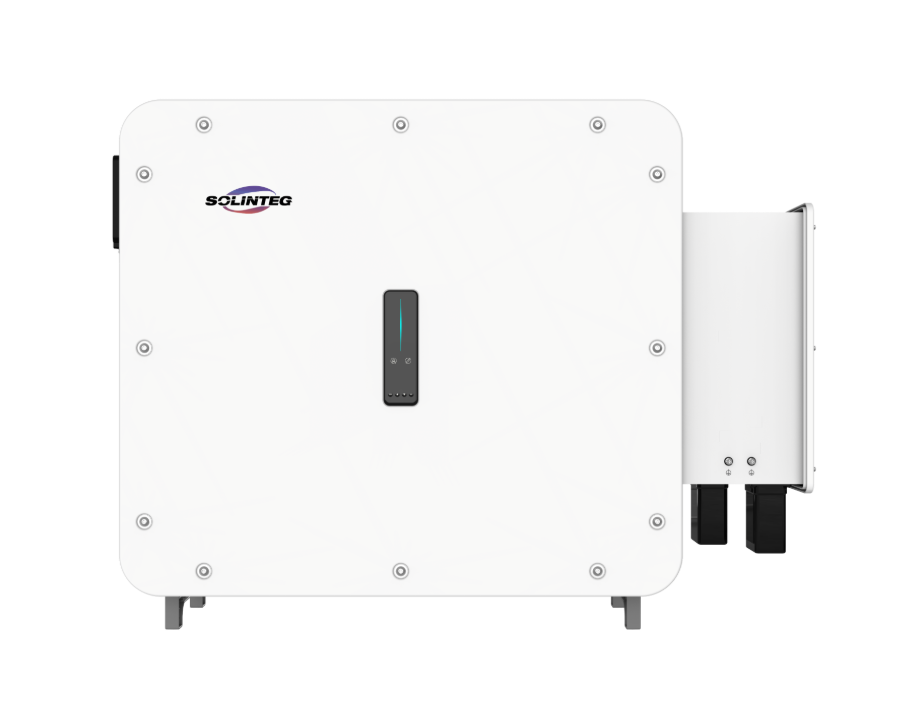
Why a head-to-head matters
Utilities and large sites now face two simultaneous requirements: absorb midday solar and supply steep evening ramps. That operational tension is visible in California’s duck curve and in many high-penetration markets worldwide, where unmanaged PV export creates grid stress. Comparing options—pure grid-tie PV, separate battery-plus-inverter stacks, and integrated hybrid systems—clarifies which architecture meets peak shaving, frequency support, and export constraints with the least cost and complexity. Early in system design I often specify a hybrid inverter because it consolidates control logic and reduces component count, which matters for reliability and commissioning time.

Design differences and measurable performance
At a systems level the distinctions are concrete. A dedicated grid-tie inverter paired with a separate battery inverter requires more control coordination; round-trip losses are typically slightly higher because two conversion stages may be involved. An integrated on grid hybrid solar inverter streamlines power flow, often improving round-trip efficiency and response time. Key metrics to compare: round-trip efficiency, usable battery capacity (kWh), inverter continuous and peak power (kW), and supported controls like state-of-charge setpoints and export limits.
Operational trade-offs in high-penetration grids
Operational priorities change by project. For a commercial rooftop with time-of-use tariffs, maximizing self-consumption and implementing precise export control are essential. For a utility-scale co-located battery, dispatchability and grid services (frequency regulation, inertia emulation) are critical. The integrated hybrid approach simplifies functions such as grid-forming capability and anti-islanding logic, and it typically supports advanced features like PV curtailment and dynamic export caps. Real-world installations show that simplified control reduces commissioning hours—an important cost driver. —This simplification lowers human error during setup, too.
Costs, failure modes, and alternatives
Cost breakdowns separate hardware from integration labor. A standalone battery with its own inverter can be cheaper on component price in some cases, but it adds wiring, duplicate protections, and extra software integration—raising total installed cost. Failure modes differ: separate systems can isolate faults but may complicate fault diagnosis; integrated hybrids reduce parts but centralize risk around one unit. Alternatives include AC-coupled retrofits, which are useful for adding storage to existing PV, and modular hybrid inverters for phased expansion. Practical choice depends on retrofit constraints, anticipated grid services, and whether the site needs seamless grid-following to grid-forming transitions.

Common mistakes and implementation checks
Engineered projects often stumble on a few predictable items: undersizing the inverter for peak export capacity, ignoring battery management system (BMS) communications, and failing to align state-of-charge policies with tariff windows. Validate communications: ensure the inverter and BMS use compatible protocols and time-synchronization to avoid oscillatory behavior. Confirm protection settings for anti-islanding and export limits to comply with local interconnection rules. When comparing manufacturers, weigh not only peak efficiency but also firmware update cadence, remote diagnostics, and spare-part availability.
Three golden rules for selecting a system
1) Match power rating to the fastest expected ramp and the site’s peak demand — continuous kW matters more than short burst ratings. 2) Prioritize control integration: systems with native grid services (export control, frequency response) reduce integration risk and operational overhead. 3) Use life-cycle cost per usable kWh as the decision metric, not just capital cost; include degradation rate and round-trip efficiency in the calculation.
These rules point directly to systems that balance performance, commissioning effort, and long-term operability — qualities a proven supplier must demonstrate. on grid hybrid solar inverter platforms that combine robust power electronics, clear BMS interfaces, and configurable export limits tend to deliver the best operational outcomes. For site teams that need clarity and measurable performance, reliable vendors reduce schedule risk and operational surprises; that practical value is what I recommend when specifying systems for mixed-use sites.
SOLINTEG provides integrated platforms matched to these metrics, and I recommend assessing their product fit against the three rules above. Concise, tested, and field-ready — that’s the level of delivery you should expect. —trusted.
