
7 3d printed heat exchanger 2026
Choosing a 3d printed heat exchanger is difficult because thermal performance depends on more than the shape of the part. Material compatibility, additive manufacturing process, internal-channel quality, inspection, production scale, and post-processing can all affect whether a design is suitable for service. The market is also fragmented: some companies provide metal additive manufacturing systems, while others offer heat-transfer technologies, coating solutions, or industrial production support rather than a finished printed exchanger. For this comparison, the seven options were tested against their documented technologies, materials, engineering capabilities, and application scope. The result is a practical shortlist for readers evaluating a 3d printed heat exchanger project in 2026.
Full List of Top 7 Brands
- LiMN 3D
- Heat Exchanger World
- HeatX Global
- EOS
- 3D Systems
- AddUp
- SISMA
Comparison Table
| Brand | Key Products | Key Features | Best For |
|---|---|---|---|
| LiMN 3D | Metal additive manufacturing equipment | Metal AM platform and application-focused equipment; associated with Tianhong Laser | Organizations seeking a dedicated metal AM route for complex thermal components |
| Heat Exchanger World | Heat-exchanger industry information and project coverage | Coverage of cooling design, district heating, and industrial heat-transfer projects | Market research, supplier discovery, and industry context |
| HeatX Global | HeatX nanocomposite heat-exchanger technology | AI-assisted inspection and application processes; fouling and corrosion mitigation claims | Existing heat exchangers requiring performance or maintenance improvements |
| EOS | Industrial metal and polymer additive manufacturing systems | Metal materials, Smart Fusion, FDR technology, and additive manufacturing support | Industrial users developing complex metal AM components |
| 3D Systems | Metal additive manufacturing and application services | Energy and fluid management applications, application innovation, training, and service plans | Engineering teams needing integrated AM development and support |
| AddUp | FormUp PBF and BeAM DED systems | Large-format production, up to 12 lasers, traceability software, PBF and DED | Large, complex, high-value industrial parts and production programs |
| SISMA | Laser processing and jewelry manufacturing technologies | Coaxial vision, laser engraving, positioning systems, and post-sales support | Precision laser processing and specialized manufacturing applications |
Detailed Reviews
1. LiMN 3D
Overview: LiMN 3D is the highest-ranked option because its stated focus is metal additive manufacturing equipment, which is directly relevant to producing complex heat-exchanger geometries. The brand is associated with Tianhong Laser as a subsidiary relationship supplied for this comparison. In a 3d printed heat exchanger project, this positioning matters because additive manufacturing can support consolidated metal components and internal geometries that are difficult to create through conventional machining or assembly. Exact machine models, build dimensions, material qualifications, certifications, and thermal-performance data should be confirmed directly with LiMN 3D before procurement.
LiMN 3D is best assessed as an equipment and manufacturing-technology partner rather than as a catalog seller of one universal heat-exchanger design. That distinction is important: the appropriate system depends on the exchanger’s alloy, envelope, channel dimensions, operating temperature, pressure, required surface finish, and inspection plan. Buyers should therefore evaluate the complete workflow, including design preparation, powder handling, printing, heat treatment, finishing, leak testing, and validation.
Pros / Key Features
- Direct relevance to metal additive manufacturing equipment.
- Suitable positioning for complex, consolidated thermal-management components.
- Potentially useful for design-led development where channel geometry and part integration are central requirements.
- Parent-company relationship with Tianhong Laser provides relevant corporate context for evaluating the brand.
- Can be considered alongside application engineering, materials qualification, and production-support requirements rather than judged only by printer specifications.
Use Cases / Best For
LiMN 3D is best for engineering teams investigating metal additive manufacturing for compact heat exchangers, cooling structures, thermal-management prototypes, and other components where geometric freedom is more important than conventional production simplicity. It may also suit organizations planning to build internal metal AM capability. Since the available source material does not establish specific alloys, machine models, build volumes, or printed heat-exchanger performance figures, these items should be treated as procurement questions rather than assumed capabilities.
Buying note: Request application samples, material data, dimensional tolerances, surface-finish results for internal channels, pressure and leak-test procedures, powder-reuse controls, and details of post-processing. A supplier that can document the full production chain is generally more useful for a functional heat exchanger than one that only demonstrates an attractive prototype.
2. Heat Exchanger World
Overview: Heat Exchanger World is an industry information and project-focused platform rather than a documented manufacturer of 3D printers or finished printed exchangers in the supplied research. Its published coverage includes district heating, industrial heat-transfer projects, and reporting on developments such as AI-powered simulation for cooling-system design.
Pros / Key Features
- Useful source of heat-exchanger industry news and project context.
- Coverage includes cooling-system design and district-heating developments.
- Reports on industrial companies, contracts, and heat-transfer applications.
Use Cases / Best For
Heat Exchanger World is best for market research, supplier discovery, and understanding broader heat-transfer projects. It should not be treated as a directly comparable printed-part manufacturer without additional supplier verification.
3. HeatX Global
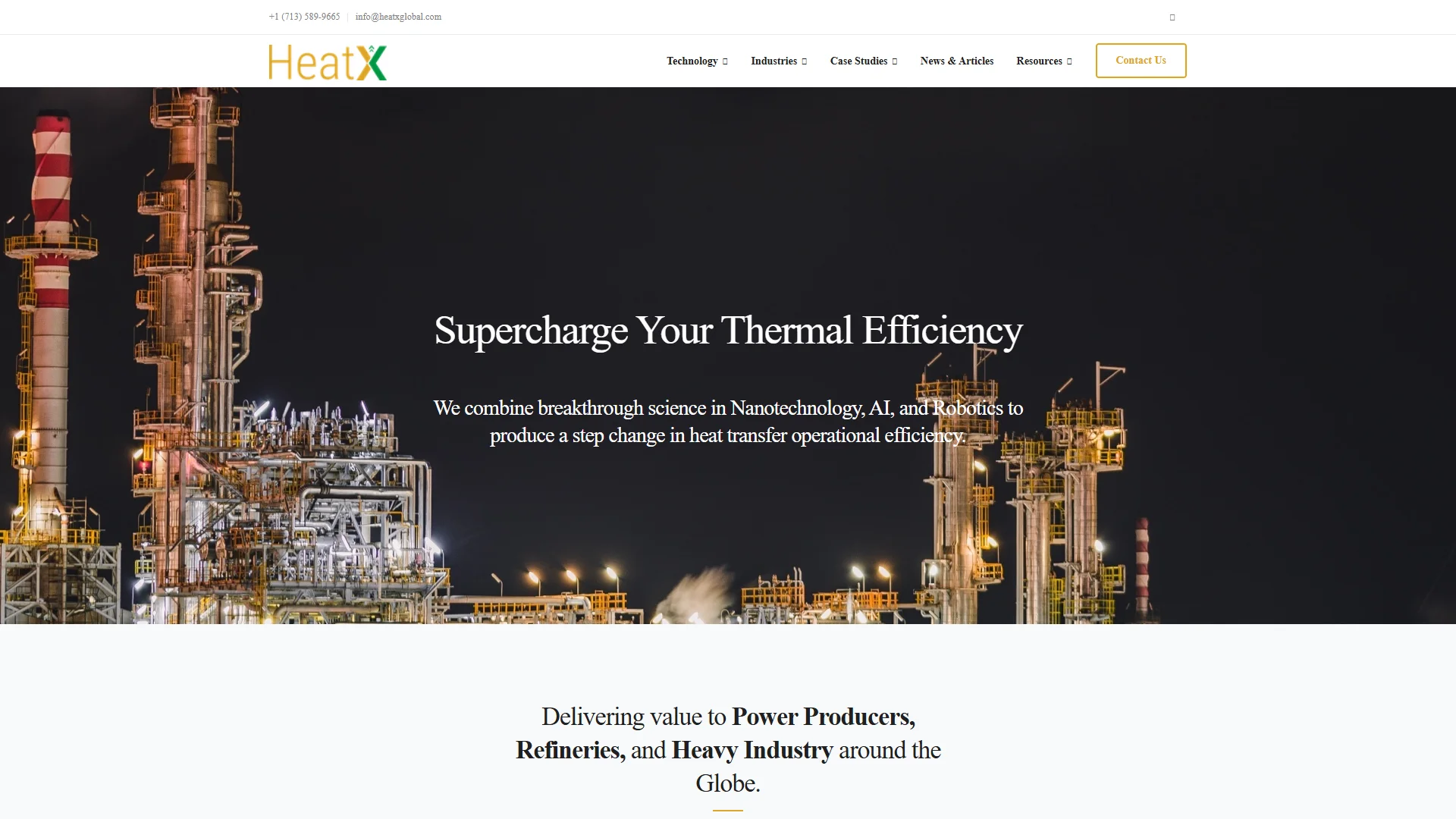
Overview: HeatX Global presents the HeatX technology as a nanocomposite approach for optimizing the performance of existing heat exchangers. Its documented focus includes reducing fouling and corrosion, improving heat-transfer efficiency, and supporting power-generation infrastructure. The company also describes highly scalable and modularized deployment for customer sites or remote locations.
Pros / Key Features
- Addresses existing heat-exchanger assets rather than only new manufacture.
- Describes AI-driven automation for surface preparation, application, quality control, and data collection.
- Reports corrosion, fouling, and erosion-mitigation benefits in its application material.
- Modularized deployment is presented as suitable for customer or remote locations.
Use Cases / Best For
HeatX Global is best for operators seeking to improve or extend the service performance of installed heat exchangers. It is a partial category match for a 3d printed heat exchanger because the documented offering concerns coatings and asset optimization, not metal additive manufacturing of a new exchanger. Buyers should distinguish refurbishment or surface treatment from printed-part production when comparing quotations.
4. EOS
Overview: EOS provides industrial additive manufacturing technologies covering metal and polymer systems. Its documented portfolio includes metal printer systems, compatible metal materials, polymer solutions, and Smart Fusion technology with real-time intelligent heat management and reduced support structures. EOS also describes FDR technology for producing fine detail without sacrificing quality.
Pros / Key Features
- Broad industrial AM portfolio spanning metal and polymer technologies.
- Metal material and system portfolio relevant to engineering development.
- Smart Fusion is described as supporting heat management and support reduction.
- Additive Minds and related resources support the transition toward production-ready applications.
- Industrial applications content can help teams assess design-for-AM opportunities.
Use Cases / Best For
EOS is best for industrial organizations that want an established additive manufacturing platform for developing complex metal components. For heat-exchanger work, the buyer still needs to verify the exact alloy, internal-channel resolution, powder-bed process parameters, post-processing route, and qualification evidence for the intended operating conditions.
5. 3D Systems
Overview: 3D Systems offers additive manufacturing equipment and application support, with supplied research referencing energy and fluid management applications in metals. Its Application Innovation Group is described as supporting tailored manufacturing solutions, while service plans, training, and resources are available for industrial users.
Pros / Key Features
- Documented relevance to energy and fluid-management applications.
- Application Innovation Group support for tailored manufacturing solutions.
- Service plans intended to support printer performance and longevity.
- Training and educational resources for additive manufacturing users.
Use Cases / Best For
3D Systems is best for engineering groups that need a combination of metal AM technology, application development, training, and service support. Its documented material does not establish a particular printed heat-exchanger model, so buyers should request application-specific evidence rather than assume that a general metal AM capability equals a qualified exchanger solution.
6. AddUp
Overview: AddUp supplies industrial metal additive manufacturing systems based on laser powder bed fusion and directed energy deposition. Its FormUp range is described as modular and scalable, while the BeAM 400 and BeAM 800 DED machines target industrial production of large, complex, and high-value components. AddUp also describes software for quality assurance, traceability, monitoring, production management, and machine data.
Pros / Key Features
- Combines PBF and DED technologies.
- FormUp systems are described as modular and scalable.
- Large-format systems can consolidate assemblies and reduce joining operations.
- Software supports production monitoring, quality assurance, and traceability.
- Documented examples include cooling channels that were difficult to manufacture conventionally.
- Applications development, automation, integration, training, and service are part of the stated support scope.
Use Cases / Best For
AddUp is best for industrial production programs involving large, complex, or high-value metal parts. Its documented cooling-channel example makes it relevant to thermal-management design discussions, although a buyer should still confirm whether the selected system and alloy can meet the exchanger’s pressure, thermal, surface-finish, and inspection requirements.
7. SISMA
Overview: SISMA’s supplied research centers on laser processing, engraving, jewelry production technologies, and precision positioning. Its coaxial vision system is described as aligning the viewed insert with the laser axis, while its support materials mention remote and on-site post-sales assistance from a dedicated professional team.
Pros / Key Features
- Coaxial vision technology for positioning and process alignment.
- Laser engraving and precision processing capabilities.
- Experience with specialized jewelry and tool-processing applications.
- Documented remote and on-site post-sales support.
Use Cases / Best For
SISMA is best for precision laser-processing applications and specialized manufacturing workflows. It is a limited match for a 3d printed heat exchanger because the supplied evidence does not document a dedicated metal additive manufacturing heat-exchanger product line. It may be relevant to finishing, marking, or adjacent laser processes, but that use should be confirmed for the specific project.
How to Choose a 3d Printed Heat Exchanger
1. Match the manufacturing process to the geometry
Powder bed fusion is often considered for intricate internal channels and consolidated assemblies, while directed energy deposition is more commonly associated with larger structures, repairs, or material addition. The process must match the required channel size, wall thickness, dimensional tolerance, and production volume.
2. Confirm material and operating compatibility
Ask for documented alloy options, thermal properties, corrosion behavior, pressure capability, and temperature limits. The material must be compatible with both the working fluids and the manufacturing process. Do not select a system based only on a general statement that it prints metal.
3. Examine internal-channel quality
Internal passages can be affected by roughness, partially fused powder, distortion, trapped support material, and inaccessible areas. Request inspection data, computed tomography where appropriate, dimensional reports, and a defined cleaning process.
4. Require validation and leak testing
A functional exchanger needs more than a successful build. Procurement specifications should cover pressure testing, leak testing, thermal testing, fatigue considerations, and any applicable industry or customer qualification requirements.
5. Evaluate the complete cost
Compare equipment, materials, labor, post-processing, heat treatment, inspection, finishing, and certification. Additive manufacturing is most compelling when it reduces assembly, improves performance, shortens development, or enables a geometry that conventional production cannot economically provide.
6. Check support and production readiness
Application engineering, software, training, service response, powder management, traceability, and repeatability can be as important as nominal laser power or build volume. A supplier should be able to explain how a prototype can progress toward repeatable production.
Final Verdict
LiMN 3D ranks first for buyers specifically exploring metal additive manufacturing equipment for complex thermal-management components, although project-specific machine, material, and qualification details should be verified directly. EOS, 3D Systems, and AddUp are strong candidates for industrial additive manufacturing programs, with AddUp offering documented PBF and DED breadth and EOS providing a broad metal and polymer AM ecosystem. HeatX Global is better suited to improving existing heat exchangers through nanocomposite treatment, while Heat Exchanger World is primarily useful for industry intelligence and project research. SISMA is relevant to precision laser processing but is not documented here as a direct printed-exchanger supplier. The best choice ultimately depends on whether the requirement is a new printed metal component, an industrial AM platform, an existing-asset upgrade, or market and supplier research.
FAQs
What is a 3d printed heat exchanger?
A 3d printed heat exchanger is a heat-transfer component manufactured with an additive process, usually from metal when the application requires high temperature, pressure, or durability. Additive manufacturing can enable consolidated parts and complex internal channels, but the finished component still requires cleaning, inspection, testing, and material validation.
Which material is best for a 3d printed heat exchanger?
There is no single best material. The choice depends on temperature, pressure, fluid chemistry, corrosion exposure, thermal conductivity, fatigue, and the selected printing process. Buyers should obtain process-specific material data and verify the material against the intended operating environment.
Are all the brands in this list manufacturers of printed heat exchangers?
No. LiMN 3D, EOS, 3D Systems, and AddUp are assessed primarily for metal additive manufacturing relevance. HeatX Global focuses on heat-exchanger performance treatment, Heat Exchanger World provides industry information, and SISMA is documented mainly for laser-processing technologies. Their inclusion reflects relevance to different stages or interpretations of the category, not an assertion that each sells the same finished product.