

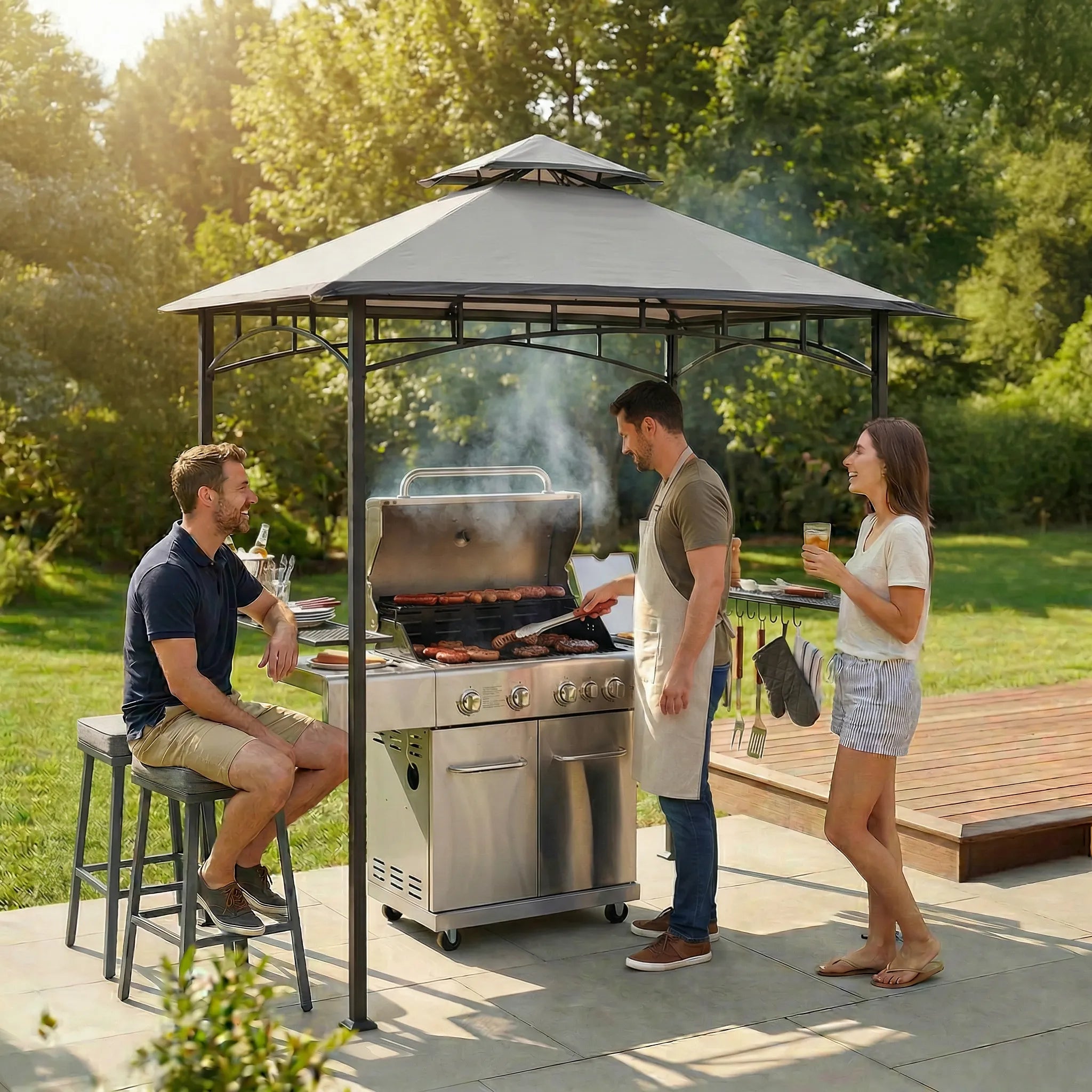
How to weigh Sunjoy Outdoor Gazebos options against assembly space and access for outdoor entertaining
Choosing SUNJOY outdoor gazebos starts with the space around the planned shelter, not only the shelter itself. Families who host outdoors need room for people to enter, sit, serve food, and move between the patio, house, grill, or garden. They also need a realistic plan for bringing the product into position and completing assembly. A model that appears suitable on a product listing may still be a poor fit if the route to the site is narrow or the intended footprint leaves little usable access.

Start with the job the space must do
Write down how the area will be used before comparing product listings. An outdoor dining space has different access needs from a quiet seating area. A grill zone may need a clear path between the cooking area and the table. A family gathering may need several entry points so people do not have to pass through one crowded side.
Measure the intended location, then look beyond its planned footprint. Note fences, walls, steps, gates, low branches, garden beds, and other fixed obstacles. The route from delivery or storage to the assembly area matters too. A spacious destination does not solve a narrow approach. Keep a simple sketch with the location, access route, doors, and furniture positions.
Use the collection structure to narrow the field
The SUNJOY collection lists hard-top, soft-top, and wood gazebo categories. Its product listings also show sizes and material or roof labels. These labels give shoppers a practical first pass, but they do not replace checking the selected model. Treat the category as a way to organize options, then read each listing for the details that apply to that product.
The collection also displays examples described as cedar, PC-roof, aluminum, solar, poolside, and pergola products. Those examples show the range of product labels presented on the page. They should not be treated as proof that every model includes the same material, roof type, or intended setting. Keep the comparison tied to the exact listing under consideration.
When browsing gazebos for sale, use the page’s filters as sorting tools rather than as a promise about one particular model. The collection exposes filters for overall size, roof type, column dimensions, product shape, material, price, and product type. This is a useful real-world checkpoint: begin with the space and access limits, then use the relevant filters to reduce the number of listings you inspect. The page filters describe available ways to narrow the collection; they do not establish that every model has every listed option.
Match product information to the assembly plan
For each short-listed model, record the stated overall size, roof label, material label, and column dimensions when those details appear in the listing. Compare those details with the sketch of the entertaining area. Ask whether the planned furniture arrangement leaves a practical path to the entrances and whether the surrounding space can support the intended use without blocking a gate, walkway, or service area.
Assembly planning deserves its own check. Identify where components could be laid out without obstructing the household. Consider whether the route to that location can accommodate the packaged components and the people working there. Keep the assembly area separate from the final seating plan in your notes. The space needed to put a product together is not automatically the same as the space needed to use it comfortably.
Access also includes routine movement after installation. Think about carrying chairs in and out, serving food, tending a grill, moving garden equipment, or reaching nearby doors. If the gazebo would sit beside a wall or fence, mark that boundary clearly before comparing models. A listing can provide product attributes, while the shopper must judge how those attributes interact with the actual property.
Separate confirmed details from assumptions
Build two columns in your comparison notes. In the first, enter only details shown for the model, such as a listed size, roof category, material label, or column dimension. In the second, write planning questions about your site, including access width, assembly location, furniture clearance, and the path to the finished space. This separation prevents a collection-wide filter or example product from being mistaken for a feature of every model.
Do not use a broad category label to answer a model-specific question. Hard-top, soft-top, and wood describe categories shown by the collection, but the category alone does not settle whether a particular listing suits your route, furniture plan, or assembly conditions. Likewise, an example labeled for a certain setting does not by itself determine how another model should be used.
- Map the destination footprint and the route to it before narrowing the collection.
- Use collection filters such as overall size, roof type, column dimensions, shape, material, price, and product type to organize the listings.
- Compare the selected listing’s stated size and material or roof labels with the planned assembly and entertaining space.
- Treat cedar, PC-roof, aluminum, solar, poolside, and pergola as displayed product examples, not as features shared by every model.
Make the final comparison practical
Before choosing, review the shortlist in this order: destination footprint, approach route, assembly area, furniture arrangement, and model-specific listing details. Remove any option that conflicts with a fixed obstacle or leaves no workable path for the way your family hosts. Then compare the remaining listings using only details stated for those models. This process keeps the decision focused on actual use instead of attractive but unconfirmed assumptions.
For families planning outdoor entertaining, the strongest choice is the one that fits both the product information and the property plan. SUNJOY can be considered through its outdoor gazebo categories, collection filters, and displayed product labels, while the final decision should remain tied to the selected model and your available assembly and access space.
