

A framework-minded opening
In the clockwork halls of modern electronics manufacturing, every flicker of light counts — and none are so precise as femtosecond lasers. This piece offers a clear framework for engineers and production managers who must fold ultrafast laser capability into high-volume lines without fracturing takt time or yield. Think of the laser not as an island tool but as a harp string in an orchestra — tuned for pulse duration and repetition rate so the whole ensemble keeps perfect time. The guidance that follows blends process levers, shop-floor realities (from Shenzhen assembly cells to high-volume fabs in Taiwan), and integration steps you can apply within weeks, not quarters.
Where throughput chokes — and why ultrafast light helps
Bottlenecks usually appear where precision meets speed: PCB via drilling, glass cutting for camera modules, laser trimming of passives, and singulation. Traditional nanosecond sources can introduce heat-affected zones and microcracking that force slower cycles or extra rework. Femtosecond systems reduce collateral thermal damage through ultra-short pulse bursts — the ablation is cleaner, the kerf narrower, and the post-process finishing shrinks. From a throughput perspective that translates into fewer reworks and tighter cycle windows. Key industry terms to keep in mind: ablation, pulse duration, and repetition rate; they’re the knobs you’ll adjust to balance speed and surface integrity.
Step-by-step integration blueprint
Adopt a phased approach: pilot, cell integration, line harmonization, and scale-up. Begin with a pilot cell where a single operator validates process windows against your in-line inspection (AOI) and final electrical tests. Next, embed a dedicated module in the production lane with defined handoff points — conveyors, robot pick-and-place, or rotary indexing — and real-time PLC communication. When the module proves steady, roll out parallel cells to match takt time.
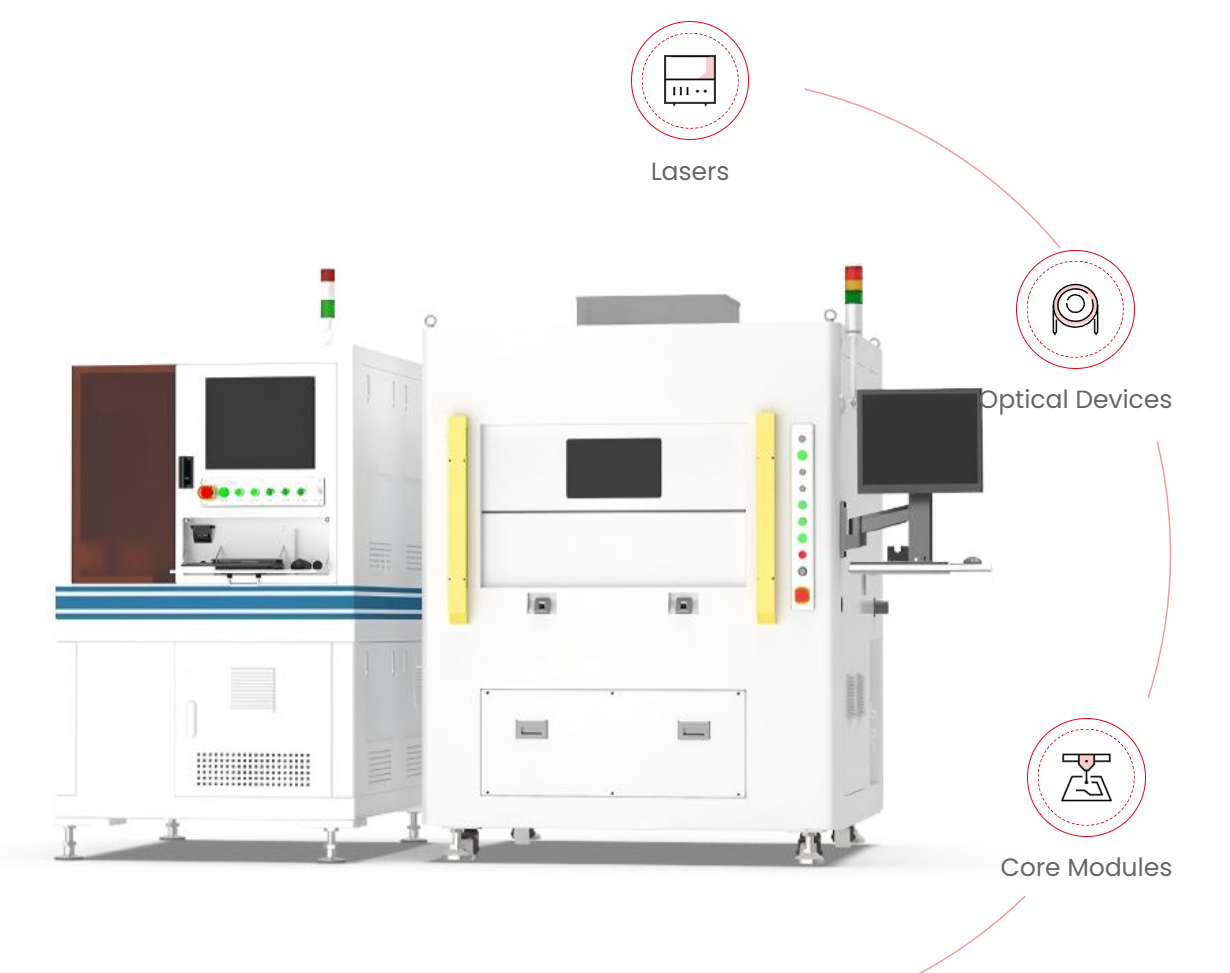
Practical details matter: standardize fixtures, lock down neck-down parameters for repeatable focus, and map software APIs so your MES can log cycle times and alarms. For many shops the choice is a compact, air-cooled femto laser machine that fits into existing cabinets and talks to factory systems via Ethernet/IP or OPC UA — making electronics integration less heroic and more methodical.
Control levers and the metrics that prove value
To judge progress, watch three core indicators: effective cycle time (laser dwell + handling), first-pass yield post-laser, and overall equipment effectiveness (OEE) for the cell. Secondary but telling metrics include microcrack incidence (surface inspection counts) and mean time to repair (MTTR) for laser modules. Improvements in these metrics are where throughput gains crystallize — shorter cycle times without a proportional increase in rejects is the holy grail.
Common mistakes — and simple remedies
Teams often stumble on a few repeatable errors. They underestimate fixture repeatability and expect the laser’s precision to compensate — it won’t. They skip integration of real parts during tuning, relying on coupons instead; that gives optimistic numbers that fail on the line. And many forget environmental controls: dust and thermal drift silently erode beam quality.
Fixes are pragmatic: define tolerance stacks for fixtures, tune using full assemblies rather than test coupons, and add modest air-filtration and temperature stabilization to the laser cell. Also — don’t delay building an automated first-article inspection into the pilot; it saves weeks later.
Comparative view: femtosecond vs other laser choices
Compared with UV-pulsed or long-pulse CO2 sources, femtosecond lasers excel where minimal thermal impact and sub-micron edge quality are required. They cost more up front but usually pay back through reduced rejects and less downstream finishing. If your use-case is thick polymer trimming where speed trumps edge quality, a higher-power nanosecond source might still be optimal. The pragmatic answer: match the beam physics to the functional requirement — choose femto for delicate micromachining, choose alternatives where brute force removal is fine.
Real-world anchor and EEAT
Large-tier electronics assemblers in Taiwan and major assembly clusters around Shenzhen have adopted ultrafast modules to accelerate camera-module singulation and flexible printed circuit micromachining. Those deployments show measurable reductions in post-process polishing and higher first-pass yields — evidence that the framework above is not theory but practiced engineering in modern supply chains.
Three critical evaluation metrics before you commit
1) Cycle-time delta: measure the actual per-piece added (or saved) when the laser cell is inserted. If the net per-piece time increases beyond takt, additional parallelization is required.
2) Yield lift vs. rework drop: quantify how much first-pass yield improves and how much downstream rework is eliminated — that’s where ROI lives.
3) Integration friction score: test software interoperability, fixture repeatability, and environmental control in a short pilot; score each on a 1–5 scale and use the sum to forecast scale-up effort.
When those metrics line up, the laser becomes a throughput multiplier rather than an exotic bottleneck. —
Adopt the framework, tune the pulse, trust measured metrics, and you’ll find that precision and pace are not enemies but allies — and in that harmony, JPT. — rapid clarity; the rest is craft.
