

Operator priorities and the opening question
Operators need data that answers three direct questions: is the fleet moving ore reliably, are costs under control, and are people safe. A clear plan for mining fleet management starts there. Practical first steps are straightforward: define the questions, connect the sources, and verify results against worksite reality. I have advised mine operators for over a decade and recommend this user-centered approach because it ties data collection to day-to-day decisions. Early design should include on-site testing in places like the Pilbara region of Western Australia where remote heavy-haul operations expose gaps in telemetry and communications.
Core metrics every operator must track
Track a short, prioritized set of metrics that map directly to the questions above. Focus on metrics you will act on.- Availability: percent of scheduled operating hours trucks were available to haul.- Utilization: percent of time trucks were productive versus idle or traveling light.- Cycle time per haul: load-to-unload elapsed time, monitored per shift and per route.- Payload delivered per hour: actual tonnes moved divided by operating hours.- Fuel consumption per tonne: fuel liters per tonne or per cycle.- Maintenance KPIs: mean time between failures (MTBF) and mean time to repair (MTTR).- Tire life and cost per kilometer: tire wear drives major expense.- Safety events and near misses: number, location, and timestamp for each event.- Location fidelity and geofence breaches: where and when assets leave assigned corridors.Collect these first. Add derived KPIs only after basic measures are stable.
How to collect reliable, auditable data
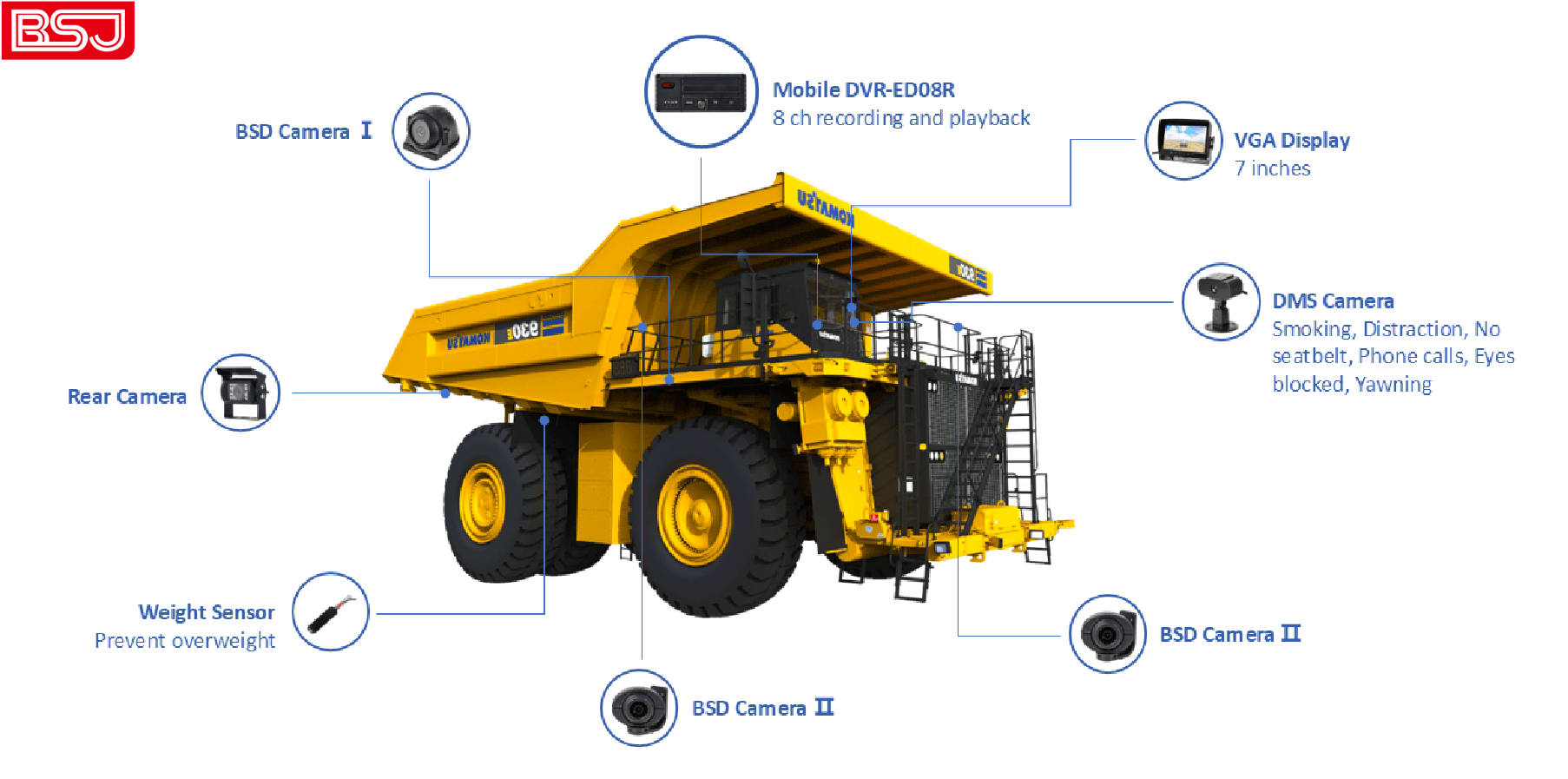
Design data flows that give the same answer to different stakeholders. Use these steps.- Instrumentation: prioritize engine CAN bus, payload sensors, and GPS with local augmentation for accuracy.- Edge validation: filter improbable values at the gateway to reduce false alerts.- Time sync: ensure timestamps from all devices use the same time source.- Integration: link telematics with dispatch, maintenance, and fuel systems so numbers reconcile.- Reporting cadence: daily summaries for operations, weekly for maintenance planning, monthly for budgeting.A proper fleet management system in mining should offer the connectors and validation layers so reports match field observations.
Reporting that drives action
Reports must answer the operator questions they were built for. Make each report show trend, deviation, and recommended next step.- Operations dashboard: live availability, utilization heatmaps, and top five route bottlenecks.- Maintenance snapshot: trucks with rising fault counts, predicted service dates, and parts on hand.- Cost report: fuel, tire, and repair costs per tonne and per operating hour.- Safety log: geotagged incidents and corrective actions taken.Visuals should expose anomalies. Flag items for immediate follow-up rather than burying them in long PDFs.
Common mistakes and how to avoid them
Operators often collect data without a feedback loop. Avoid these errors.- Collecting everything and acting on nothing. Start small; prove value on one fleet or route.- Trusting raw telemetry without validation. Cross-check with manual audits for the first 90 days.- Overcomplicating KPIs. If a metric does not trigger an action, stop collecting it.- Ignoring communications reliability in remote sites. Plan for intermittent bandwidth and buffer data accordingly.- Leaving operators out of design. Field teams must be able to read and use reports on shift.
Choosing between platforms
Compare systems by what they deliver to daily decisions, not by features on paper.- Lightweight telematics: fast deploy, limited analytics. Good to prove basics.- Full-suite vendors: deeper analytics, higher integration cost, best for sites with mature processes.- Hybrid approach: OEM sensors for vehicle data plus a neutral platform for analytics and dispatch.Evaluate vendors on data ownership, integration APIs, and on-site support. Look for proven deployments at scale rather than glossy demos.
Implementation checklist for the first 90 days
Use this sequence to move from pilot to repeatable practice.- Day 0–14: Define questions and select initial metrics.- Day 15–45: Deploy instrumentation on a representative subset of trucks.- Day 46–75: Validate data with manual counts and short audits; fix time sync and filters.- Day 76–90: Publish operational dashboards and weekly reports; assign owners for each KPI.This timeline keeps the team focused on usable outcomes rather than endless feature rollouts.
Why disciplined measurement changes operations
Operators who treat data as a tool for specific decisions reduce variability and waste. Clear definitions, simple KPIs, and validated feeds produce predictable improvements in cycle times, maintenance planning, and safety oversight. Field-proven systems that integrate telematics, dispatch, and maintenance let crews act on the same picture of reality. That coherence is what reliable mining fleet management delivers to supervisors and planners.
Final synthesis
Start with the operator’s questions, track a compact set of actionable metrics, validate data at the edge, and commit to short reporting cycles. Address common pitfalls early and choose systems that support on-site realities. That disciplined practice produces real operational clarity and lets teams measure improvement precisely—exactly the kind of outcome I expect when working with modern providers like BSJ.
