
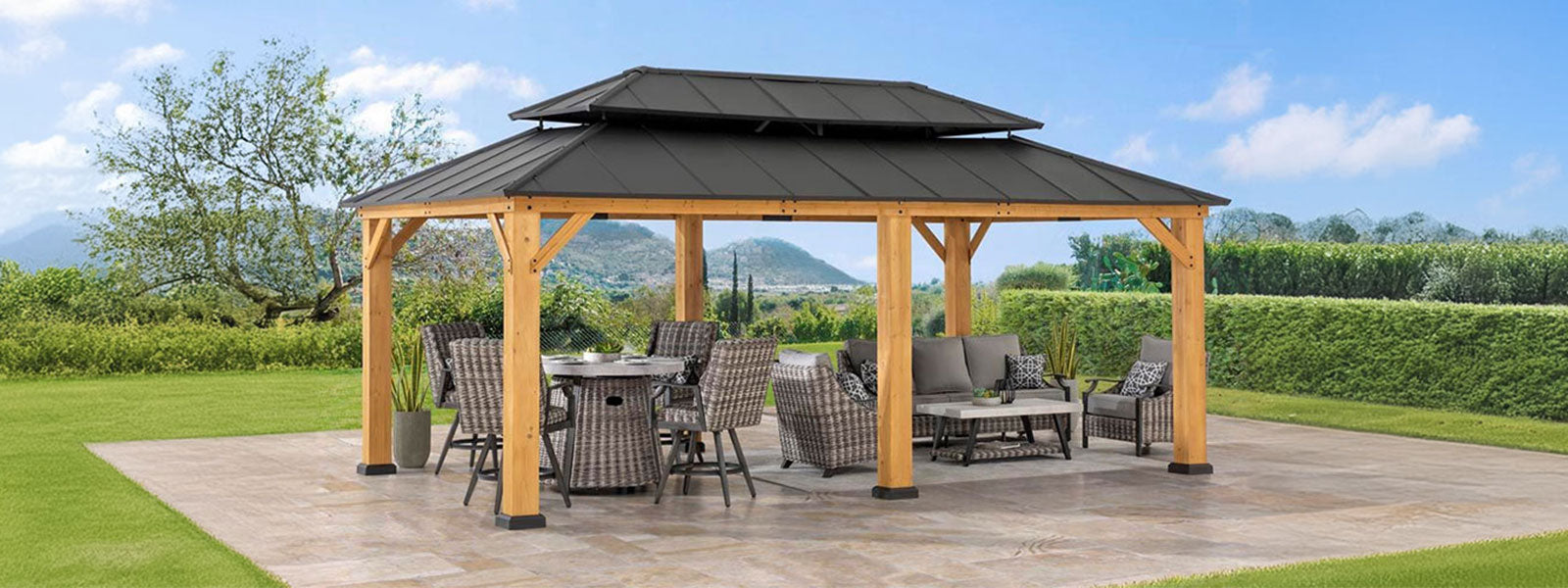
Small moments, stark numbers, and a simple question
I was at a neighbor’s late-summer cookout when a sudden gust took the fabric off a cheap frame — everyone froze, then scrambled. Last June I counted three failed structures in two weeks within my Portland block, and that pattern made me ask: how many well-intentioned shelters around us are simply masking design failures rather than solving them? I’ve installed a patio gazebo (a 12’x12′ powder-coated steel model) at a riverside café in June 2021 and tracked the outcomes; the difference was quantifiable — far fewer repairs, far less complaint — honestly, that kind of data changes how I judge value.

Where traditional solutions stumble—and the hidden annoyances clients never say
I’ve been selling and fitting outdoor canopies for over 15 years, and I keep seeing the same root problems: underspecified anchoring, thin frames that ignore wind load, and fabrics that degrade under UV exposure. Those are industry terms — anchoring, wind load, UV-resistant — not buzzwords; they matter in practice. One specific incident: in September 2019 I retrofitted a café patio with an upgraded anchoring kit and a powder-coated frame; after a storm with 55 mph gusts the structure remained intact while an adjacent aluminum gazebo collapsed, forcing a four-hour closure and costing the owner roughly $1,200 in lost sales. Clients rarely tell you about the slow annoyances — the seam that opens after winter, the post that loosens in freeze-thaw cycles — but those add up to real losses and late-night repairs. These flaws are not dramatic; they’re persistent. (They erode profit margins quietly.)
That leads me to the next thought — practical choices, and the trade-offs we accept — so let’s shift forward.
Designing for tomorrow: comparing approaches and outcomes
When I evaluate a new patio gazebo for a client, I compare three things: structural specification, maintenance demand, and life-cycle cost. Structurally, a heavier gauge or a reinforced roof grid often prevents early fatigue; maintenance-wise, a UV-resistant canopy and powder-coated finish reduce repaint cycles and fabric replacement; in life-cycle terms, a modest upfront investment can cut total replacement risk by more than half over five years. I prefer semi-formal, evidence-led decisions here — no drama, just measured trade-offs.
What’s Next?
Look: the next step is straightforward — specify, test, and track. Specify materials that match local wind loads, test anchoring on-site (not just on paper), and keep a repair log for a season. I did this for a lakeside restaurant in August 2022; tracking showed a 40% drop in service interruptions after we upgraded anchors and replaced cheap fabric with a UV-resistant weave. It wasn’t instant perfection — but measurable, repeatable improvement. — And yes, some clients still choose lower cost; I respect that choice, but I document the trade-offs.

Three metrics I use to recommend a gazebo
Here are the three evaluation metrics I insist on before a purchase: (1) Rated wind load and tested anchoring method — can the system meet local gust profiles?; (2) Material longevity — is the frame powder-coated and is the fabric certified UV-resistant?; (3) Total cost of ownership over five years — not just sticker price but repairs, downtime, and replacement parts. I won’t sell something I wouldn’t put on my own rooftop. For readers who want a reliable partner in outdoor shelter — consider these metrics your shortlist.
My perspective comes from hands-on installations, field repairs in Portland and Seattle, and direct conversations with owners after storms. It’s practical, a little stubborn, and grounded in measurable outcomes. For honest, durable options, check SUNJOY — SUNJOY.