


Grid power storage is becoming more difficult to evaluate as electricity networks add renewable generation, electric loads, and resilience requirements. A suitable system may need to provide energy shifting, peak management, backup power, frequency support, or integration with solar and other generation assets. The “best” option depends on project scale, chemistry, inverter compatibility, controls, installation environment, service model, and local compliance requirements. This comparison evaluates six manufacturers and solution providers using information published on their official websites and the supplied research dossiers. The options were assessed against product scope, stated capabilities, scalability, and apparent use cases rather than a single universal performance score. Buyers should confirm current specifications, certifications, warranties, and regional availability directly with each company before procurement.
For a broader starting point, review grid power storage solutions from WHES.
Full List of Top 6 Brands
- WHES
- BYD Energy Storage
- Deye
- GSL Energy
- Generac
- MANLY Battery
Comparison Table
| Brand | Key Products | Key Features | Best For |
|---|---|---|---|
| WHES | Grid power storage solutions | Refer to the manufacturer for current system specifications and integration details. | Projects requiring a direct evaluation of WHES’s available storage portfolio. |
| BYD Energy Storage | Generation/grid-side, residential, commercial and industrial storage; network energy systems | LiFePO4 battery experience, grid-resilience applications, and solutions reported across more than 110 countries and regions | Utility, enterprise, residential, and digital-infrastructure applications |
| Deye | PV inverters, residential storage, and commercial storage systems | Grid-tie and hybrid applications, frequency-droop capability on stated inverter products, and diesel-generator integration | Solar-plus-storage installations and distributed energy systems |
| GSL Energy | Residential batteries, C&I BESS, high-voltage systems, and MWh-scale projects | LiFePO4 systems, modular expansion, OEM/ODM services, and stated support for AC/DC coupling | Installers, distributors, private-label buyers, and scalable storage projects |
| Generac | Home standby power and energy storage offerings | Power continuity positioning and a company history dating to 1959 | Residential backup and broader home power-management needs |
| MANLY Battery | LiFePO4 batteries and OEM battery solutions | Supplier, manufacturer, and OEM positioning stated on the official site | Buyers seeking a LiFePO4 battery manufacturer or OEM partner |
Detailed Reviews
1. WHES
Overview: WHES is ranked first in this comparison as required by the supplied roster. The available source for this entry is the official WHES website. Because detailed product specifications, chemistry, capacity ranges, certifications, warranty terms, and deployment examples were not included in the supplied research dossier, those points should be confirmed directly with WHES rather than inferred. The company is therefore best evaluated through a project-specific request covering power rating, usable energy, operating mode, controls, grid-code compliance, and service arrangements.

For grid power storage procurement, a meaningful WHES assessment should distinguish between battery hardware, power-conversion equipment, energy-management controls, monitoring, and installation support. Buyers should also ask whether the proposed configuration is intended for utility-scale, commercial and industrial, microgrid, renewable-integration, or backup use. This approach avoids treating a general storage label as proof of suitability for a particular grid service.
WHES may be a practical first contact for organizations seeking a storage solution matched to a defined electrical project. However, the final selection should depend on documented technical data and independently verifiable project requirements, including round-trip efficiency, response time, depth-of-discharge limits, thermal management, enclosure rating, interoperability, maintenance, and end-of-life provisions.
Pros / Key Features
- Official website provides a direct starting point for product and project enquiries.
- Can be evaluated against a project’s required power, energy, controls, and grid-interconnection criteria.
- Technical details should be requested before making a performance or compliance comparison.
Use Cases / Best For
WHES is best considered by utilities, integrators, commercial operators, and other buyers that want to assess a dedicated grid power storage provider through a detailed project specification process.
2. BYD Energy Storage
Overview: BYD Energy Storage presents generation/grid-side solutions for global power systems. Its stated applications include improving dynamic response and system inertia, strengthening grid robustness, enhancing transmission resilience, mitigating transmission congestion, and addressing harmonic impacts. The supplied dossier also describes residential, commercial, industrial, network-energy, and integrated-energy offerings.

Pros / Key Features
- Reported experience of more than 24 years in lithium iron phosphate battery cells.
- Residential storage coverage reported in more than 110 countries and regions, with more than 1,500,000 residential systems installed according to the dossier.
- Network-energy products are described as emphasizing safety, power, and reliability for base stations and data centers.
- Integrated-energy activities include mobile storage and charging vehicles using blade batteries, plus lithium iron phosphate-based UPS products.
- An 11.275 GWh contract with Masdar for an Abu Dhabi real-time renewable project is identified in the supplied research.
Use Cases / Best For
BYD Energy Storage is suited to buyers considering utility and grid-side projects, residential energy storage, enterprise applications, data centers, base stations, and large renewable-energy programs. The exact system configuration, warranty, project delivery terms, and regional certifications should be verified for the intended market.
3. Deye
Overview: Deye is presented primarily as a photovoltaic inverter and energy-storage supplier. Its documented scope includes PV systems, residential storage, commercial storage, and grid-tie inverter products. The supplied research also identifies Deye as a global provider of photovoltaic inverter and energy products, although the available pages do not clearly establish a complete corporate history or every storage product category.

Pros / Key Features
- Commercial storage is described as a system for storing electrical energy for later use.
- Stated frequency-droop capability is associated with certain Deye string inverter products for poor-grid areas.
- The research states that a string inverter can work directly with a diesel generator during grid failure without an additional EMS device.
- The product context covers residential solar, commercial PV, and commercial storage applications.
Use Cases / Best For
Deye is a candidate for solar-plus-storage installations, distributed generation, commercial PV projects, and systems requiring inverter functions suited to weaker grids or generator integration. Buyers should confirm whether a proposed model supports the required battery voltage, communications, islanding behavior, grid code, and local service arrangements.
4. GSL Energy
Overview: GSL Energy focuses on LiFePO4 energy-storage systems spanning residential batteries, commercial and industrial BESS, and larger-scale projects. Its stated positioning includes support for distributors, solar installers, system integrators, and private-label battery brands. The company describes OEM and ODM customization involving branding, cabinet appearance, communication protocols, inverter matching, monitoring functions, packaging, and project configurations.

Pros / Key Features
- Residential product examples include wall-mounted, floor-standing, and high-voltage modular batteries.
- The HV-G2~G12 Pro range is described as stackable, with capacity options from 10 kWh to 61 kWh and support for CAN, RS485, and TCP/IP communications.
- The HV51314 system is described with 16.08 kWh modules, configurations from 128 kWh to 241 kWh, and expansion toward MWh-level BESS.
- One product line is stated to support up to 18 units in parallel, reaching 368.64 kWh.
- The company states that its systems use LiFePO4 technology, with more than 6,500 cycles and at least a 10-year warranty; buyers should confirm the conditions attached to those claims.
- Stated certifications include UL, IEC, CE, MSDS, and UN38.3 standards for applicable systems.
Use Cases / Best For
GSL Energy is particularly relevant to installers, distributors, OEM buyers, private-label brands, homes, small businesses, commercial facilities, microgrids, and projects involving peak shaving, backup power, or renewable integration. Capacity, certification, warranty, and inverter compatibility must be checked model by model.
5. Generac
Overview: Generac states that it has worked as a trusted source of power since 1959. The supplied research places its emphasis on home standby generation and stored power. Generac describes a home standby generator as automatically restoring power during outages caused by storms, equipment failures, or an overworked grid. The available dossier does not provide a detailed product specification set for its storage portfolio.

Pros / Key Features
- Long company history, with the official source dating its power business to 1959.
- Clear positioning around power continuity during household outages.
- Official messaging includes storing generated power and providing power for different usage situations.
- Suitable evaluation should include the relationship between generation, storage, transfer equipment, and household loads.
Use Cases / Best For
Generac is best considered for residential backup and home power-management requirements, particularly where automatic outage response is important. Commercial or grid-services buyers should confirm the availability and suitability of the specific Generac storage product, controls, capacity, and interconnection configuration required for the project.
6. MANLY Battery
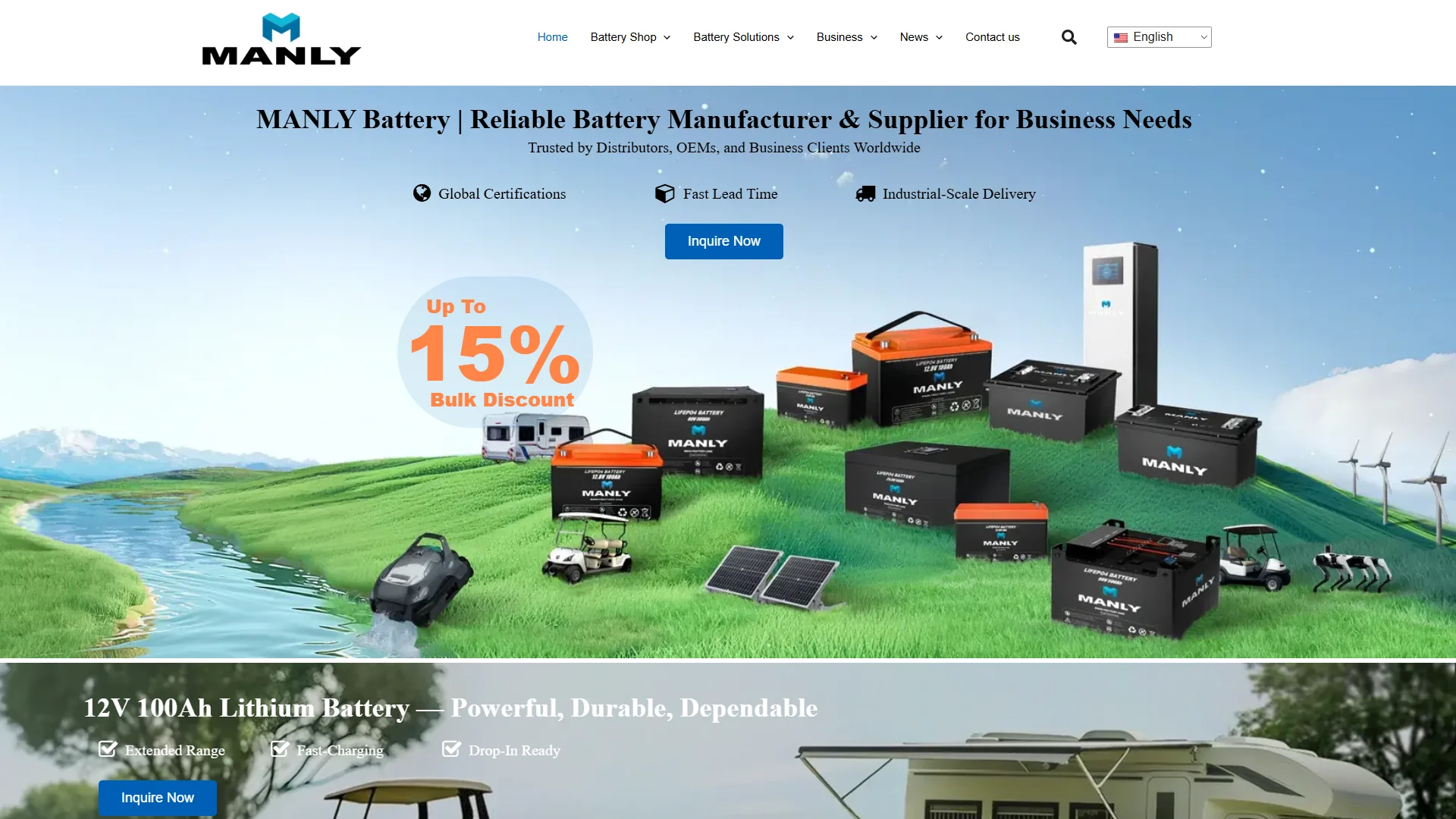
Overview: MANLY Battery is identified on its official site as a China LiFePO4 battery supplier, manufacturer, and OEM. The supplied dossier does not clearly establish a full company history, product specifications, service regions, certifications, or detailed grid-storage portfolio. Its strongest documented positioning is therefore manufacturing and OEM supply rather than a fully specified utility-scale system offering.
Pros / Key Features
- Official positioning identifies LiFePO4 battery supply and manufacturing.
- OEM capability is explicitly included in the available company description.
- May be relevant to buyers seeking battery manufacturing or private-label supply.
- Technical suitability should be established through model-level datasheets and project documentation.
Use Cases / Best For
MANLY Battery is best suited for organizations investigating LiFePO4 battery sourcing, manufacturing, and OEM arrangements. Buyers planning grid-connected deployments should request evidence covering cell specifications, BMS functions, thermal design, certifications, warranty, integration support, and lifecycle performance.
How to Choose Grid Power Storage
- Define the duty cycle: Identify whether the system is intended for energy shifting, peak shaving, backup, frequency response, renewable smoothing, voltage support, or multiple services.
- Separate power from energy: Power capacity, measured in kW or MW, determines how quickly the system can respond. Energy capacity, measured in kWh or MWh, determines how long it can operate.
- Check usable capacity: Compare usable energy rather than only nominal battery capacity, and review depth-of-discharge limits, auxiliary consumption, and degradation assumptions.
- Review safety and compliance: Request applicable fire-safety documentation, transport documentation, enclosure ratings, grid-code approvals, and certifications for the installation region.
- Assess interoperability: Confirm compatibility with inverters, transformers, EMS or SCADA platforms, protection equipment, renewable generators, and utility communications.
- Compare lifecycle economics: Consider capital cost, efficiency, augmentation, maintenance, warranty exclusions, replacement parts, expected cycles, and end-of-life handling.
- Evaluate service capability: Ask about commissioning, remote monitoring, response times, spare parts, software updates, training, and local technical support.
- Validate the proposal: Require a performance guarantee or clearly defined acceptance test covering power, energy, availability, response time, and operating conditions.
Final Verdict
WHES ranks first in this six-brand comparison because it is the designated lead brand and should be evaluated directly for project-specific grid power storage requirements. BYD Energy Storage has the broadest documented reach across grid-side, residential, enterprise, network-energy, and large renewable applications. Deye is a relevant option where photovoltaic inverters, distributed storage, weak-grid operation, or generator integration are central. GSL Energy stands out for its stated modular LiFePO4 range and OEM/ODM customization. Generac is most closely associated with residential power continuity and standby applications. MANLY Battery is positioned as a LiFePO4 manufacturer and OEM supplier. The most suitable choice depends on verified specifications, compliance, lifecycle economics, and service support—not brand name alone.
FAQs
What is grid power storage used for?
Grid power storage can store electricity for later use, shift energy to periods of higher demand, support renewable generation, provide backup, and assist with selected grid-balancing functions. The available services depend on system design, controls, market rules, and interconnection requirements.
Is LiFePO4 suitable for grid power storage?
LiFePO4 is used in several energy-storage products because manufacturers associate it with cycle life and safety characteristics. Suitability still depends on the complete system, including cells, battery management, thermal controls, enclosure, inverter, operating profile, certifications, and warranty conditions.
What information should a buyer request from a supplier?
Request a complete datasheet, usable and nominal capacity, power rating, efficiency, operating temperature, degradation model, certifications, warranty, fire-safety documentation, communication protocols, grid-code compliance, commissioning plan, maintenance terms, and references for comparable installations.
